Płaszów Concentration Camp in Kraków

The Infamous Entrance to Auschwitz Death Camp
The Scales from my Eyes
I have spent a huge part of my adult life visiting memorial sites connected to both world wars, and I have come to realise that a single lifetime is nowhere near enough to absorb it all. Every journey uncovers another layer of history, another detail overlooked, another uncomfortable truth waiting in the shadows.
Like many people of my generation, I had watched the acclaimed movie Schindler’s List. I watched it with horror, captivated by the cinematography and the brutality unfolding on screen. Yet, looking back, I realise how much I failed to fully absorb. Some of the most important details were hidden in plain sight, buried within subtitles I barely followed.
One revelation in particular stopped me cold.
The sadistic Nazi commandant Amon Göth, chillingly portrayed by Ralph Fiennes in Schindler’s List, was not actually operating inside Auschwitz, as I had long assumed (pictured above).
Instead, I discovered he was hunting human beings from the balcony of his villa at the lesser-known Płaszów Concentration Camp, on the outskirts of Kraków and not far from Schindler’s factory (pictures below). From there, survivors recalled how he would casually take aim at prisoners he believed deserved immediate execution.
For anyone shaking their head at my lack of attention, I understand completely. I was so engrossed by the extraordinary filmmaking and the horrific contradictions of humanity shown on screen that the subtitles became secondary. Truthfully, that is true of many subtitled films I have watched. At the time, my knowledge of the Holocaust was limited — and if I am honest, there is still far more I do not know than I do.
It was only during a visit to Auschwitz, while reading through the historical information there, that I first encountered the word “Płaszów” and began to understand its connection to the Holocaust. Since I was staying in Kraków, I decided to investigate further.
What I discovered astonished me.
Although retreating Nazis attempted to erase the camp from existence, substantial traces of Płaszów still remain. Even more striking was learning that Spielberg had used the area extensively while filming Schindler’s List.

The Old Grey House, once situated in the centre of the operational Płaszów Camp, now stands near the present-day access point. During the war it was used as a prison within the camp, a place where prisoners who failed to perform hard labour adequately — or who simply disobeyed orders — were punished.
Today, the building stands empty and silent, almost stripped of humanity itself. It feels less like an abandoned structure and more like a lingering witness to the atrocities committed within its walls. In the cellar cells, Jews were tortured and frequently beaten to death. Some of the cells were so small there was only enough room to stand.
Plans are currently underway to convert the building into part of the Płaszów Memorial Museum.
Directly opposite stands a modern apartment development, built on the site associated with the execution of architect Diana Reiter, who was portrayed in Schindler’s List.

The Old Jewish Cemetery at Płaszów was desecrated by the Nazis, who forced Jews to remove gravestones so they could be used in the construction of a road leading into the concentration camp. That road also appears in Schindler’s List.
Unlike the original road, however, the one seen in the film was recreated as part of a movie set using imitation headstones. Remarkably, the remains of Spielberg’s set can still be seen today on the opposite side of the camp quarry, where much of the filming took place and where remnants of the camp itself still survive.
I have also been told that the original gravestone road now lies buried beneath the tarmac road running behind the Old Grey House today, although I have not independently verified this claim.

For me, this pile of rocks symbolises the hatred and absolute power Amon Göth held over the Jewish prisoners under his control.
According to survivors, Göth regularly reminded prisoners that he alone controlled whether they lived or died, declaring himself their “God”. Accounts of his cruelty are almost beyond comprehension. Punishments and executions were carried out arbitrarily, often driven by impulse rather than reason.
Work parties could be lined up and random prisoners selected for execution without warning. Sometimes it was revenge for disobedience or escape attempts; other times it appeared to be nothing more than a demonstration of power.
Göth also kept Great Dane dogs, reportedly trained to attack and kill prisoners on command.
What terrified prisoners most was his unpredictability. Survivors recalled desperately trying to avoid eye contact or hide whenever he approached, because nobody knew what mood he might be in or who might become his next victim. If one prisoner escaped, others from the same work detail could be murdered as collective punishment.
One account describes Göth destroying the camp mortuary with explosives during a party attended by SS officers — an act of theatrical brutality intended purely to entertain his guests.

In Schindler’s List, one of the most memorable scenes involving this bridge shows Jewish families carrying the last of their possessions as they are forced from their homes.
Most had lived in Kazimierz, Kraków’s Jewish quarter, before being relocated across the Vistula River into the ghetto at Podgórze. Families who had once lived comfortable lives suddenly found themselves crammed into overcrowded rooms shared with strangers. Others ended up sleeping in the streets.
Spielberg deliberately filmed the bridge scene in reverse direction because modern buildings visible in the real backdrop would have broken the historical illusion. As a result, the crowds seen in the movie appear to be walking toward Kazimierz rather than toward the Podgórze Ghetto.
During the war there were two main bridges crossing the Vistula between Kazimierz and Podgórze. One of them, Krakus Bridge, was destroyed during the final stages of the Second World War. Both bridges were used during the forced relocation of Jews into the ghetto, although anecdotal accounts suggest Krakus Bridge saw the heaviest use during these deportations.
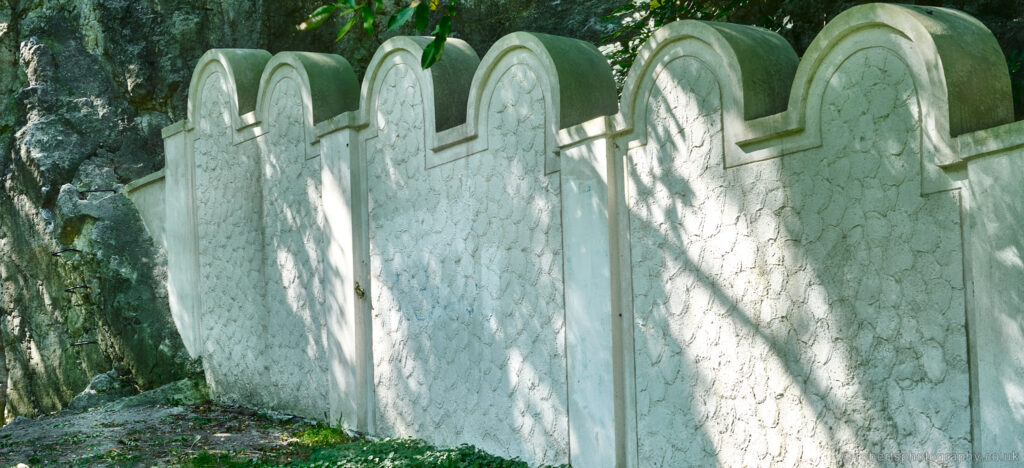
Only two surviving sections of the original ghetto wall still exist today.
Most photographs online show the easier section to locate, situated alongside the main road leading from central Kraków past Ghetto Square. I chose instead to feature this section because it disappears directly into a cliff face.
If you look carefully, you can still see a metal ladder embedded into the rock.
Standing there, it is impossible not to imagine desperate people climbing those steps under cover of darkness, slipping in and out of the ghetto to smuggle food, supplies or messages.
If the ladder is difficult to see, you can enlarge the image using right click and “view image” — or on a Mac, Control Click and “view image” — to open the full-sized version.

In Kazimierz, Kraków’s historic Jewish quarter, several filming locations used by Spielberg still remain.
One of the most recognisable has become informally known as “Schindler’s Passage”, a narrow walkway connecting Beera Meiselsa Street to Józefa Street. Visitors may instantly recognise it from the film, particularly from scenes involving the young boy Adam, who risks his own life helping Mrs Drezner and her daughter Danka hide beneath the staircase.
Today, the atmosphere could hardly be more different.
The passage is now home to small art shops, bicycle hire stores and street food vendors where visitors sit drinking coffee, tea, soft drinks or beer — ordinary life continuing in a place once associated with terror and survival.


For prisoners no longer considered useful to the workforce at Płaszów, the outcome was usually death or deportation to Auschwitz.
Those who survived the transport often arrived at Birkenau packed into cattle trucks before being unloaded onto a railway ramp in the centre of the camp. To one side the red brick road — today mostly broken fragments of brickwork.

New arrivals immediately underwent selection for labour based largely on appearance, physical condition and age.
Most prisoners arriving from Płaszów were already in appalling condition. The majority were sent directly to the gas chambers. In reality, the odds of surviving even the first day were devastatingly low — perhaps as few as twenty in every hundred.

Those deemed fit for labour were often simply worked to death later or murdered once they became too weak to continue.
The few considered “fortunate” enough to walk along the red brick road toward the barracks were entering a system designed around exhaustion, starvation, brutality and industrialised killing.
Overall survival at Auschwitz was close to impossible.
Women with young children were commonly sent straight to the gas chambers alongside their sons and daughters. Elderly people, the infirm, disabled individuals and lone children were also selected for immediate murder.
The chances of surviving selection could fluctuate depending on labour shortages inside the camp. Some prisoners who would ordinarily have been killed immediately might temporarily survive if additional slave labour was required at that moment.
The Nazi system was methodical. Human life was reduced to calculation, usefulness and disposal.

This is the actual villa where Amon Göth lived while commandant at Płaszów Concentration Camp.
Recently purchased and renovated by a local property developer, the building still stands overlooking the landscape where so many suffered and died.
Perhaps that is the right outcome.
Evil should never be allowed the final word.
Article and Photos by: David Glover Roberts
Published: 10 March 2025
One thought on “Płaszów Concentration Camp in Kraków”
Comments are closed.